Featured essay · Sri Thyaga Brahma Gana Sabha, Vani Mahal
Shri Gananatham Bhajare
An exploration of Muttuswami Dikshitar's divine compositions on Shri Mahaganapati
How does one comprehend a nameless, formless, all-pervading Nirguṇa Brahman? Muttusvami Dikshitar’s compositions reveal one answer: approach the formless through form, and let philosophy become sound.
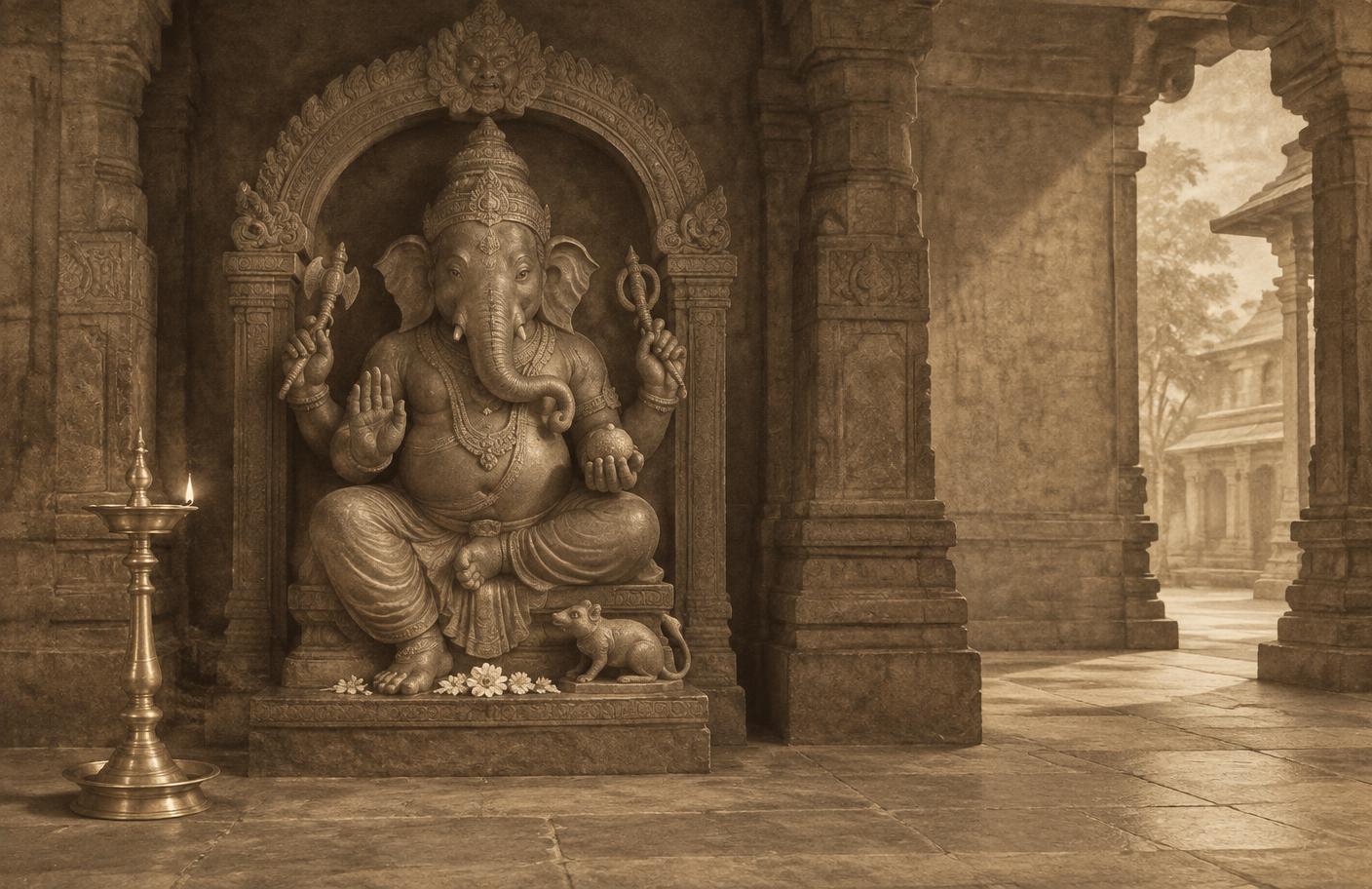
In the Hindu tradition, the one Ātma-vastu manifests in many forms. With the sanction of the Śruti, Smṛti and Purāṇas, six principal modes of worship were articulated by Ādi Śaṅkara Bhagavatpāda: Gāṇāpatyam, Kaumāram, Śaivam, Śāktam, Vaiṣṇavam and Sauram. Each offers a distinct path towards Brahma-jñāna through the worship of Gaṇapati, Subrahmaṇya, Śiva, Ambā, Viṣṇu or Sūrya.
Śaṅkara was the great exponent of Advaita — “Brahma satyam, jagan mithyā; jīvo brahmaiva nāparaḥ”: Brahman alone is real, the world is appearance, and the individual self is none other than Brahman. Yet, for human comprehension, he gave these six traditions a clear place in spiritual practice. It is for this reason that he is remembered as Ṣaṇmata-sthāpanācārya.
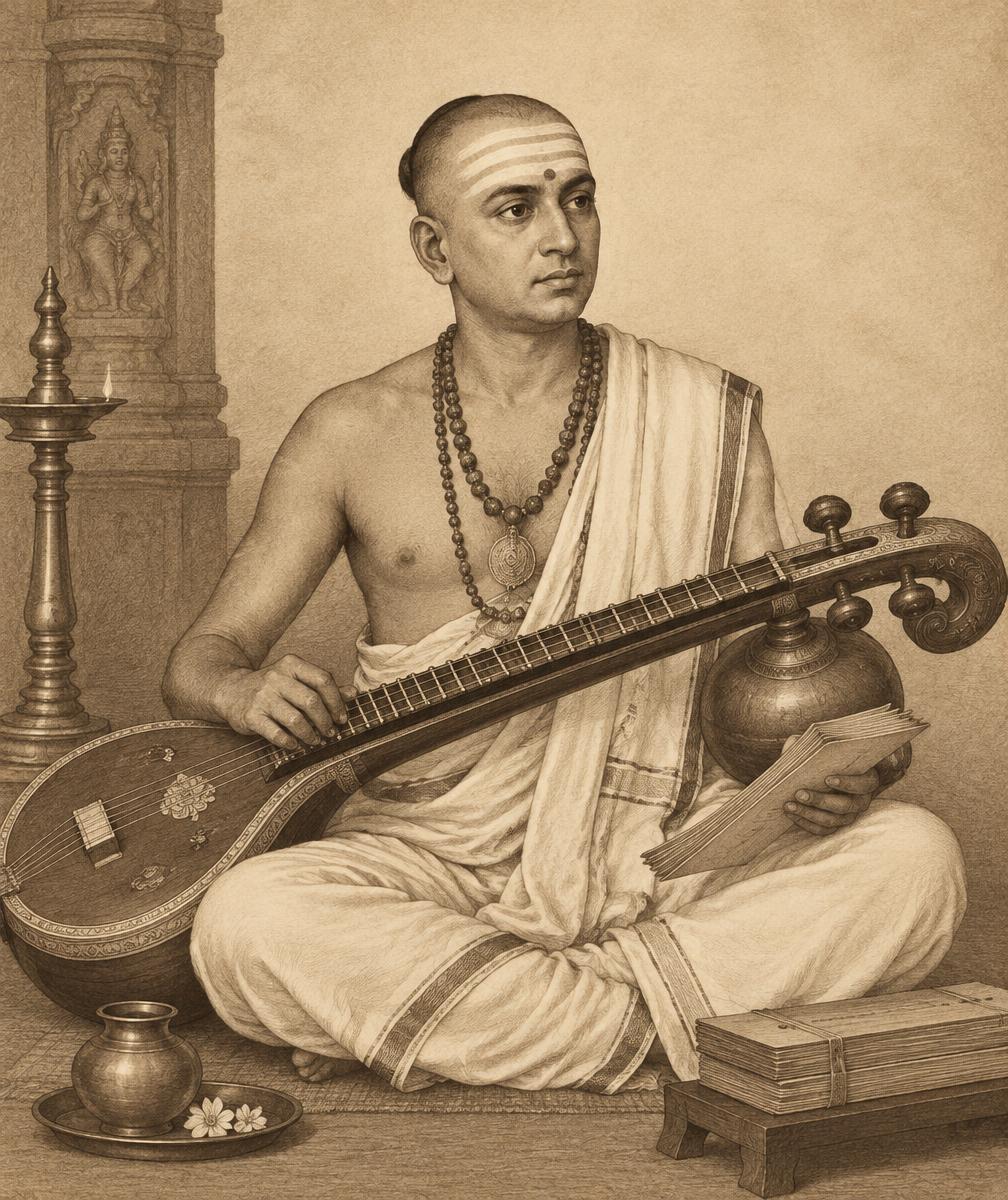
Muttusvami Dikshitar followed this Advaitic vision in its fullness. Across his compositions, the world’s illusory nature, the nirguṇa character of Brahman and the vision of every deity as the one Brahma-vastu appear again and again. He composed on the deities of all six traditions; here, our attention rests on his extraordinary musical contemplation of Gaṇapati.
Gaṇapati is not merely described in these compositions. Mantra, iconography, sacred geography and metaphysics are made audible through rāga and sāhitya.
I
Vātāpi Gaṇapatim and sacred geography
Vātāpi Gaṇapatim is among Dikshitar’s best-known compositions. Its rāga, Hamsadhvani, was created by his father Ramasvami Dikshitar. The title carries a history of its own.
In 642 CE, during the reign of the Pallava king Narasimhavarman, the commander Parañjōti led an expedition against the Chalukyas at Vātāpi — present-day Badami. Tradition holds that, after the Pallava victory, Parañjōti brought an image of Gaṇapati from Vātāpi to Tamil country. One account places it at Tiruchengattangudi, Parañjōti’s home and the kṣetra associated with Gaṇapati’s vanquishing of Gajamukhāsura. Another associates the image with the inner precinct of the Tyāgarāja temple at Tiruvarur. Parañjōti himself is believed to have renounced warfare and become the Śaiva saint Siruthondar Nāyanār.
The historical details remain debated. What matters to the musical imagination is Tiruvarur: Dikshitar’s birthplace, a city whose shrines inspired a vast body of his work. In Vātāpi Gaṇapatim, the phrase mūlādhāra-kṣetra-sthitam unfolds on two levels. Tiruvarur is itself known as Mūlādhāra Kṣetra; and Gaṇapati is the presiding deity of the mūlādhāra chakra.
II
Mūlādhāra, breath and the fourfold word
The mūlādhāra is the foundational energy centre, depicted as a red, four-petalled lotus bearing the syllables va, śa, ṣa and sa. Kuṇḍalinī rests there, coiled three and a half times around a triangle. Through japa, yoga and mantra-sādhana, she rises through the subtle centres by way of the suṣumnā, piercing the knots and uniting with Śiva-tattva at the thousand-petalled sahasrāra. The sādhaka’s journey culminates in liberation.
Gaṇapati presides over the mūlādhāra and, with it, the earth element. Dikshitar’s celebrated Pañcabhūta kṣetras usually lead the listener through Kanchipuram, Tiruvanaikaval, Arunachalam, Sri Kalahasti and Chidambaram. Yet the Devī-vaibhavāścarya-aṣṭottara invokes Tiruvarur as Valmīkapura-madhyasthā, a seat of pṛthvī. The anthill-formed Valmīka Liṅga at Tiruvarur further signifies earth. The phrase mūlādhāra-kṣetra-sthitam therefore holds body and landscape together.
valmīkapuramadhyasthā jambūvananivāsinī
aruṇāchalaśṛṅgasthā vyāghrālayanivāsinī
śrīkālahastinilayā kāśīpuranivāsinī
śrīmatkailāsanilayā dvādaśāntamaheśvarī
Because the mūlādhāra is red, Gaṇapati too is associated with vermilion: Purandara Dāsa’s gītam addresses him as “Śrī Gaṇanātha sindūra-varṇa.”
Dikshitar also presents Gaṇapati as prāṇa and as lord of the four stages of speech named in the Vedas: parā, paśyantī, madhyamā and vaikharī. Parā is the absolute, formless word at the mūlādhāra. Rising like Kuṇḍalinī, it gradually acquires attributes, becoming paśyantī, then madhyamā, and finally the spoken word, vaikharī. As Praṇava-svarūpa, Gaṇapati is the very form of Om.
This analogy between Gaṇapati and Kuṇḍalinī also explains the serpent imagery: nāga-yajña-sūtradharam, says Śrī Gaṇanātham Bhajare — he who wears the serpent as sacred thread. Gaṇapati is also shown with a serpent around his waist.
III
When philosophy becomes music
To gather these tattvas into musical form is one of Dikshitar’s great achievements. Sāhitya and saṅgīta cannot be examined in isolation: their union is like that of Śiva and Śakti.
The version of Vātāpi Gaṇapatim preserved in Subbarama Dikshitar’s Saṅgīta Sampradāya Pradarśini differs from the form commonly heard today. Tradition attributes many of the later, elaborate saṅgatis to Mahā Vaidyanātha Sivan. Subbarama Dikshitar, protective of his family’s musical inheritance, is said to have viewed such alterations with dismay; despite Sivan’s stature, he did not include him in the Vāggeyakāra Caritramu. To encounter the earlier melodic framework with the ears of the present is to rediscover a timeless composition.
Hamsadhvani is often presented through the linear clarity of its scale. Here, however, Dikshitar reveals unexpected combinations, mirroring phrases and poruttams, without compromising either rāga-rakti or textual aptness. His use of svarākṣara is equally beautiful.
The words Hamsadhvani-bhūṣita open another philosophical door. Ham and saḥ form the ajapa mantra sounded by every breath. Tradition counts 21,600 breaths in a day — 10,800 by day and 10,800 by night — all under Gaṇapati’s governance as prāṇa-śakti. The guru, no different from the godhead, occupies the sahasrāra; that seat too is signified by ham and saḥ. Thus the phrase may be heard as “he who revels in the resonance of the ajapa mantra.”
IV
The many forms of Mahāgaṇapati
The Mudgala Purāṇa describes thirty-two forms of Gaṇapati. The first sixteen are the Ṣoḍaśa Gaṇapatis; several are distinctive iconographic forms, and a number are enshrined at Tiruvarur. Drawing upon their dhyāna ślokas and iconography, Dikshitar made these forms live in composition. Alongside them are more general invocations and works associated with particular kṣetras.
Heramba and Pañcamātaṅga-mukha
Heramba Gaṇapati has five elephant faces and rides a lion. The form found at Tiruvarur is described with remarkable precision in the dhyāna śloka: his hands grant fearlessness and boons, and bear the noose, tusk, rosary, goad, axe, hammer and modaka. The form may also be read as an embodiment of the five elements, five subtle essences, five senses, their five actions and prāṇa — twenty-one principles, a number sacred to Mahāgaṇapati.
abhayavaradahastaṁ pāśadantākṣamālā-
sṛṇiparaśudaṇḍaṁ mudgaraṁ modakaṁ ca
phalamadhigatasiṁhaḥ pañcamātaṅgavaktraḥ
gaṇapatir-atigauraḥ pātu herambanāmā
Mahāgaṇapati with Śakti
At the entrance to the sanctum of Tyāgarāja at Tiruvarur is a ten-armed Mahāgaṇapati with Śakti. Red in hue, elephant-faced, moon-crested and three-eyed, he embraces Śakti seated upon his lap. His hands carry pomegranate, mace, sugarcane bow, discus, lotus, noose, blue lily, paddy, tusk and a pot of gems. Dikshitar’s Hasti-vadanāya in Navaroj mirrors this visualization.
Even the rāga-mudrā reveals his ingenuity. “Navaroj,” a word not naturally accommodated by Sanskrit, is embedded across the phrase Guruguha-samāna-vara-ojase: samāna-vara-ojase.
V
Ucchiṣṭa Gaṇapati: a secret vidyā
Ucchiṣṭa Gaṇapati is celebrated, yet esoteric. The tradition requires that this vidyā be approached through a guru, with both jñāna and bhakti. It is closely connected to the Śrīvidyā sampradāya in which Dikshitar was deeply learned.
At Tiruvarur, the shrine of Ucchiṣṭa Gaṇapati stands at the entrance to the Kamalāmbā shrine. Kamalāmbikā embodies the confluence of Śiva and Śakti at the bindu, and it is here that Dikshitar offered his Kamalāmbā Navāvaraṇa cycle. The proximity of the two shrines is therefore profoundly apt.
In the Ramakriya composition Ucchiṣṭa-gaṇapatau — Ramakriya corresponding to Kamavardhani in the other system — Dikshitar begins:
ucchiṣṭa-gaṇapatau bhaktiṁ kṛtvonnata-padavīṁ vraja re re hṛdaya“O heart, cultivate devotion to Ucchiṣṭa Gaṇapati and attain the exalted state.” The line itself insists upon the bhakti and elevated disposition required to approach the form.
VI
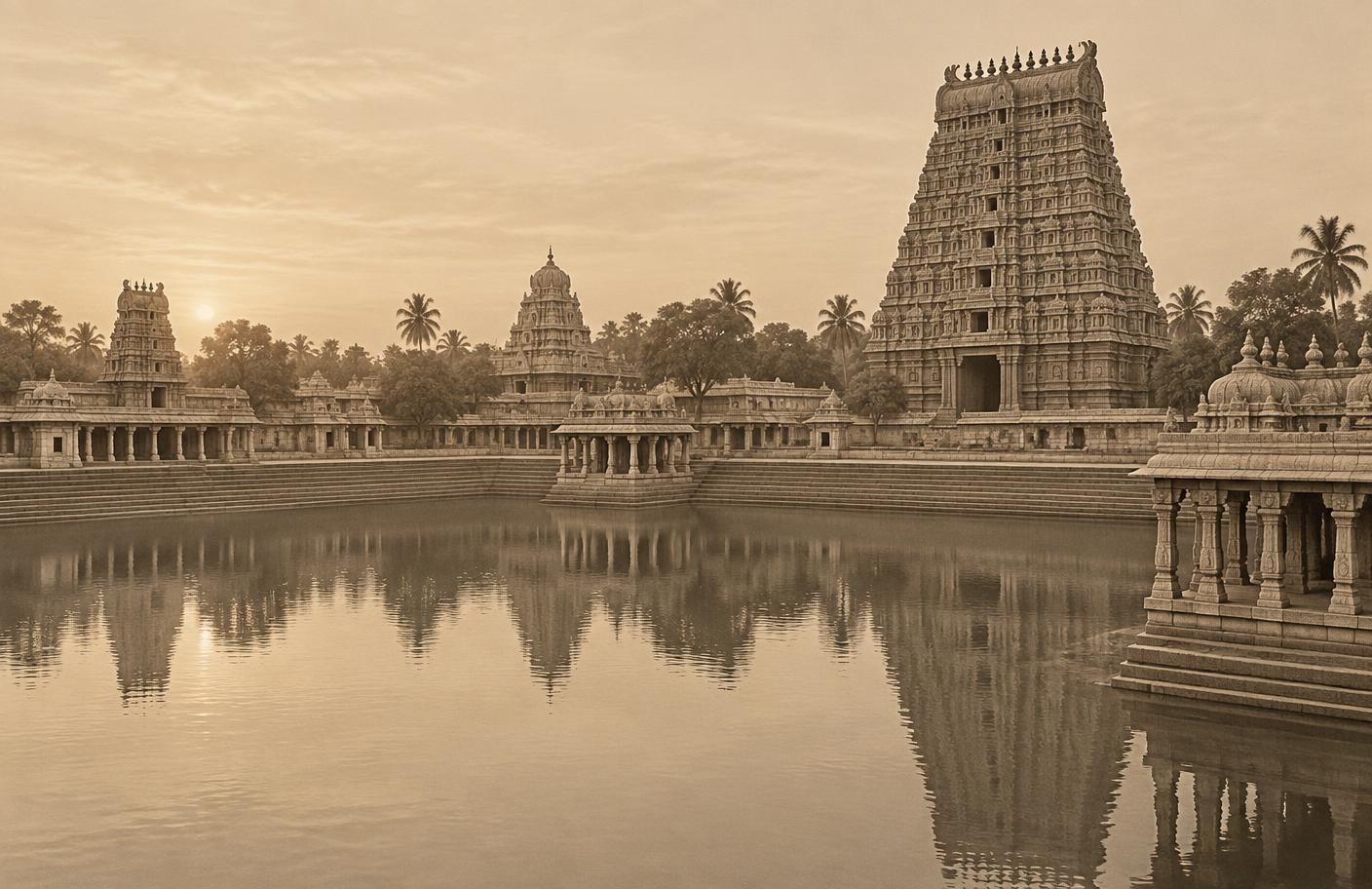
Tiruvarur: story, shrine and song
The Purāṇas offer many accounts of Gaṇapati’s origin. In one narrative from the Varāha Purāṇa, the devas, obstructed in their work, approach Parameśvara. Śiva reflects that all the pañcabhūtas possess perceptible forms except ākāśa, and smiles; from that smile emerges Gaṇapati as the embodiment of the five elements.
The Lalitā Sahasranāma offers a complementary vision: “Kāmeśvara-mukhāloka-kalpita-Śrī-Gaṇeśvarā; Mahāgaṇeśa-nirbhinna-vighna-yantra-praharṣitā.” Gaṇapati comes forth from the glance exchanged between Śakti and Śiva. When Viśukra traps Lalitā’s army in the Jaya-vighna-yantra, Mahāgaṇapati shatters it and delights the Goddess. Thus he is worshipped at the beginning of every undertaking.
Dikshitar alludes to this in Śrī Gaṇeśātparam in Ārdradeśi. The composition touches the thirty-six tattvas of creation — from Śiva, Śakti and Sadāśiva through mind, senses, subtle essences and, finally, the five elements. In mātaṅga-vadanāt umā-rudra-darśitāt, the theological reference also carries the rāga-mudrā: umā-rudra.
Mūlādhāra Gaṇapati
Near the Tyāgarāja shrine at Tiruvarur is a small image of Gaṇapati framed by a three-coiled serpent — Mūlādhāra Gaṇapati. Dikshitar’s composition in Śrī rāga presents him as the force governing breath and as the remover of sorrow born from mūla-ajñāna, primal ignorance. Curiously, a characteristic phrase of the Dikshitar lineage, S N P D N P, does not occur in the composition at all — a musical wonder compared, in the lecture, to the inscrutable grace of Mūlādhāra Gaṇapati himself.
Māṟṟu Uraitta Vināyaka
Another Tiruvarur story belongs to the poet-saint Sundarar. At Vriddhachalam, Śiva rewarded him with twelve thousand gold coins. Fearing robbery on the journey home, Sundarar sought Gaṇapati’s counsel. He was told to place the coins in the temple tank at Vriddhachalam and retrieve them from the Kamalalayam tank at Tiruvarur. When the recovered gold appeared to differ in quality, Sundarar sang in praise; Vināyaka restored its original lustre. The shrine came to be known as Māṟṟu Uraitta Vināyaka — the Gaṇapati who attested the fineness of the gold.
Dikshitar subtly recalls the legend in Śrī Mahāgaṇapatim in Gauḷa, through the phrase suvarṇākarṣaṇa-vighnarāja.
Śveta Gaṇapati
When Indra was cursed by sage Durvāsā, tradition says that he worshipped a Gaṇapati formed from the foam of the cosmic ocean. This is Śveta Gaṇapati, associated with the celebrated white Vināyaka at Tiruvalanjuli near Thanjavur. Dikshitar addresses him in Śveta Gaṇapatim, set in Rāgacūḍāmaṇi. Once more, the rāga-mudrā is woven naturally into meaning: mātaṅga-mukhaṁ vallabhā-sametaṁ virāga-cūḍāmaṇim — Gaṇapati, united with Vallabhā, is the crown jewel of dispassion.
A musical theology
The auspicious beginning
Composers and saints across the ages have praised Mahāgaṇapati. Śiva worshipped him before Tripura-saṁhāra; Devī before the destruction of Mahiṣāsura; and Kṛṣṇa, in the story of the Syamantaka jewel, to free himself from false accusation. Dikshitar gathers these resonances in Mahāgaṇapate pālaya mām in Nāṭanārāyaṇi.
In these kritis, Gaṇapati is at once a beloved deity, the guardian of beginnings, the ground of the subtle body, the breath within the ajapa mantra, and Brahman approached through form. Dikshitar does not place philosophy beside music as commentary. He makes philosophy sing.