

Insights from a lecture-demonstration by Vidwan Sri R.K. Shriramkumar at Sri Thyaga Brahma Gana Sabha, Vani Mahal
Introduction: The Path to the Formless Through Form
How does one comprehend a nameless, formless, all-pervading Nirguna Brahman? This profound question lies at the heart of Hindu dharma, and the answer, beautifully articulated through centuries of spiritual wisdom, is multifaceted. Among the various paths prescribed in our tradition, the most prominent approach involves worshipping the absolute as Saguna Brahman—the divine manifested in form.
The singular Atma Vastu, the ultimate reality, reveals itself in countless manifestations. From this infinite pantheon, six primary forms have been identified and sanctioned by the Shruti, Smriti, and Puranas. These six paths were formally recognized by Adi Shankara Bhagavatpada, earning him the title Shanmatha Sthapanacharya (the establisher of six paths). These six mathas represent distinct approaches to realizing Brahma Jnana through devoted worship of specific deities:
- Ganapatyam – Worship of Ganapati as Brahman
- Kaumaram – Worship of Subrahmanya as Brahman
- Shaivam – Worship of Shiva as Brahman
- Shaktam – Worship of Ambal (the Divine Mother) as Brahman
- Vaishnavam – Worship of Vishnu as Brahman
- Sauram – Worship of Surya as Brahman
Each of these paths offers a unique doorway to the same ultimate truth, expressing the journey to Brahma Jnana through the worship of these specific deities.

The Advaita Legacy: From Adi Shankara Bhagavatpada to Muttuswami Dikshitar


Though Adi Shankara stood as the pinnacle of Parama Advaita, proclaiming “Brahma-Satyam Jagan-Mithyā Jivo Brahmaiva Nāparaḥ” (Brahman alone is real, the world is illusory, the individual soul is none other than Brahman), he recognized the necessity of comprehensible paths for spiritual seekers. Thus, he established these six mathas as practical means to approach the ineffable.
The quintessential teachings of Adi Shankara’s Advaita Vedanta found their musical embodiment in the compositions of Muttuswami Dikshitar, who followed these teachings in all aspects—embracing both the Shanmatha traditions and the profound principles of Advaita Vedanta. Throughout Dikshitar’s vast repertoire, we encounter compositions that illuminate the illusionary nature of this world (Maya Shabalita), expound upon the Nirguna Swaroopa (formless nature) of Brahman, and reveal every deity as a manifestation of the singular Brahma Vastu.
Dikshitar composed kritis on all the deities of the Shanmathas, but this study focuses specifically on his profound compositions dedicated to Ganapati—perhaps the most adored and celebrated form in Hindu worship.
Ganapati: The Remover of Obstacles
As we all know, Ganapati holds a unique position in Hindu tradition. Without his pooja, no undertaking can proceed smoothly, free from obstacles. His distinctive form, including his elephant head, is explained in numerous mantras and beautifully elaborated in Dikshitar’s compositions.
Vatapi Ganapatim: A Masterpiece in Hamsadhwani
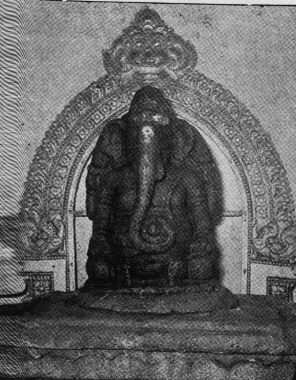
Among Dikshitar’s compositions on Ganapati, “Vatapi Ganapatim” stands as one of the most celebrated. The ragam Hamsadhwani itself carries special significance, being a creation of Dikshitar’s father, Ramaswami Dikshitar. The composition’s title references a fascinating historical narrative that intertwines devotion, warfare, and divine grace.
The Legend of Vatapi Ganapati
During the reign of Narasimha Varman of the Pallava dynasty, his commander-in-chief, Paranjothi, led the Pallava army to war against the Chalukyas in Vatapi (present-day Badami, Karnataka). In 642 CE, Pulakeshin of the Chalukyas was decisively defeated. Following the victory, the Pallava army plundered the city of Vatapi.
When Paranjothi was offered any reward for his valor, he chose the magnificent Ganapati idol from Vatapi and brought it to his hometown, Thiruchengattangudi. This village is also renowned in legend as the place where Ganapati vanquished Gajamukhasura with his tusk, causing the entire area to be smeared with blood, giving rise to its distinctive name (the Tamil word for red being embedded in the place name).
An alternative account suggests that Paranjothi later repented for his actions during the war and transformed into the Shaivite saint Siruthondar Nayanar in his later years. According to this version, he brought the Vatapi Ganapati to Tiruvarur and established the idol within the inner prakara of the Thyagaraja Swami temple.
While the exact location remains debated, the prevalent belief holds that the idol of Vatapi Ganapati was indeed established in Tiruvarur, its iconography clearly resembling the Chalukya style of sculptural art.
Muladhara Kshetra: The Sacred Geography and Subtle Anatomy
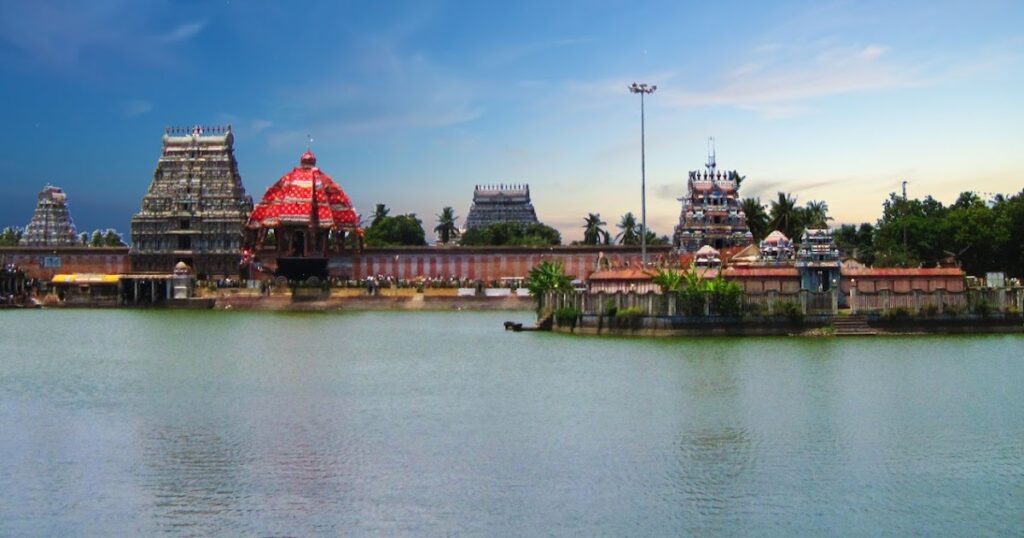
Muttuswami Dikshitar, born in the sacred town of Tiruvarur, dedicated numerous compositions to the various shrines of this holy city. In “Vatapi Ganapatim,” he mentions ‘Muladhara Kshetra Stitham’—a phrase laden with multiple layers of meaning that reveal Dikshitar’s profound understanding of both sacred geography and yogic philosophy.
Tiruvarur itself is known by several names, including Muladhara Kshetra, Parashakti Puram, and Kamalalaya. But the reference to Muladhara carries deeper significance when we explore its connection to the subtle body.
In yogic anatomy, the human body contains six primary centers of energy extending from the base of the spine to the brain. These energy centers, called chakras, form a vertical axis of spiritual development. The bottommost chakra is the Muladhara Chakra, visualized as an energy center with four petals inscribed with the letters व, श, ष and स. This chakra is characterized by its red color and serves as the resting place of the Kundalini Shakti.
Within the Muladhara exists a triangle, around which the Kundalini lies coiled three and a half times. Ganapati presides over this foundational chakra and is identified with the Kundalini Shakti itself. Through practices of Japa, Yoga, and Mantra Sadhanas, the Kundalini awakens and rises, passing through all six energy centers—Muladhara, Swadhistana, Manipura, Anahata, Vishuddhi, and Ajna. As it ascends, it breaks through energetic knots via the Sushumna, the subtle channel running parallel to the spinal cord, ultimately uniting with the Shiva Tattva at the Sahasrara—the thousand-petalled lotus at the crown of the head. Through this sadhana, the practitioner attains liberation.
The Earth Element and Panchabhuta Kshetras
Ganapati’s presidency over the Muladhara chakra connects him intrinsically with the earth element (Prithvi). This association is reinforced through the concept of Panchabhuta Kshetras—five sacred sites representing the five elements. Dikshitar himself references these in his compositions:
- Kanchipuram (Prithvi – Earth)
- Tiruvanaikaval (Ap – Water)
- Arunachalam (Agni – Fire)
- Sri Kalahasti (Vayu – Air)
- Chidambaram (Akasha – Ether)
However, the Devi Vaibhava Ascharya Astottaram offers an alternative designation for the earth element. In this text, while describing the Panchabhuta kshetras, we find:
Valmīkapuramadhyasthā jambūvananivāsinī |
Aruṇāchalaśṛṅgasthā vyāghrālayanivāsinī || 27 ||
Śrīkālahastinilayā kāśīpuranivāsinī |
Śrīmatkailāsanilayā dvādaśāntamahēśvarī || 28 ||
Here, “Valmīkapuramadhyasthā” refers to Tiruvarur as the Prithvi Kshetram. The Valmika lingam in Tiruvarur also signifies the earth element, creating a powerful connection between Ganapati, the earth element, and this sacred geography.
Interestingly, Ganapati is also referred to as Panchabhutatmaka—the embodiment of all five elements—demonstrating the all-encompassing nature of this deity.
The Symbolism of Red: Sindhoora Varna
The Muladhara chakra’s red color establishes another significant connection with Ganapati. This association with red is celebrated across various devotional traditions. As the great composer Purandara Dasa proclaims in his gitam: “Sri Gananatha Sindhoora Varna” (Sri Ganapati of the red hue).
The Four Levels of Speech and the Pranava
In “Vatapi Ganapatim,” Dikshitar masterfully weaves together profound philosophical concepts. He describes Ganapati as the Prana Tattva (the vital life force) and as the lord of the four-fold speech (Vak)—a concept rooted in the Vedic understanding of language and consciousness.
The Vedas speak of “Chatvari Vaakpadani”—the four levels of speech:
- Para – The absolute, formless stage that emanates from or resides in the Muladhara chakra
- Pashyanti – The stage where consciousness begins to take form
- Madhyama – The intermediate stage of mental formulation
- Vaikhari – The final stage of articulated, spoken word
This Para rises like the Kundalini itself, progressively gaining attributes as it ascends through Pashyanti and Madhyama, ultimately manifesting as Vaikhari—the spoken word we experience in our daily communication.
Dikshitar identifies Ganapati as Pranava Swaroopa—the embodiment of the sacred syllable Om, the primordial sound from which all creation emanates.
The Serpent Connection: Naga Yagna Sutradharam
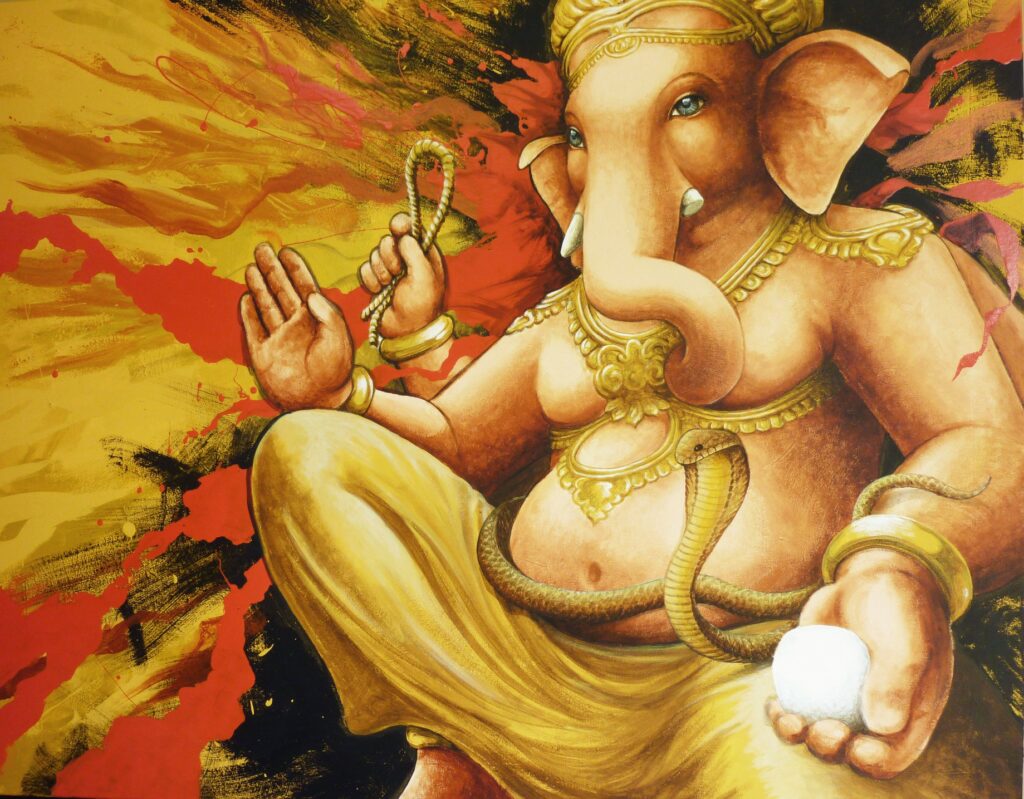
The analogous nature of Ganapati and the Kundalini creates a profound connection between the deity and the Naga (serpent). The Kundalini’s serpentine form, coiled at the base of the spine, establishes this symbolic relationship. In his composition “Sri Gananatham Bhajare,” Dikshitar refers to “Naga Yagna Sutradharam”—Ganapati wearing the sacred thread of serpents. Traditional iconography also depicts Ganapati wearing the Naga around his waist, further emphasizing this mystical connection.
The Confluence of Sahitya and Sangita
Dikshitar beautifully incorporates all these philosophical concepts—the Tattvas, the Kundalini, the chakras, the levels of speech—into a cohesive musical form. This integration demonstrates a crucial principle: Sahitya (lyrics) and Sangita (music) should never be viewed in isolation. Instead, they must be experienced as the union of Shiva and Shakti—inseparable, complementary, and mutually illuminating.
The Textual Tradition and Musical Evolution
In Subbarama Dikshitar’s “Sangita Sampradaya Pradarshini,” “Vatapi Ganapatim” appears in a form notably different from how it is commonly performed today. The basic structural framework varies significantly from contemporary renditions. Historical accounts suggest that the legendary musician Maha Vaidyanatha Iyer added numerous beautiful sangatis (variations) to the composition, creating the version we hear today.
This development, however, brought disappointment to Subbarama Dikshitar, who felt that his family’s traditional compositions were being altered without authorization. His annoyance was such that he deliberately excluded Maha Vaidyanatha Iyer from the “Vaggeyakara Charitramu” (biographical section) of his book, despite the latter being a highly renowned vidwan of that era.
Yet, this textual history reveals something beautiful in itself. The discovery and reconstruction of these timeless lost compositions, understood through our present-day comprehension of swaras and musical structure, becomes an act of reverence and revival.
Musical Innovations in Vatapi Ganapatim
pallavi
vAtApi gaNa patiM bhajE(a)haM
vAraNAsyaM vara pradaM SrIanupallavi
bhUtAdi saMsEvita caraNaM
bhUta bhautika prapanca bharaNaM
(madhyama kAla sAhityam)
vIta rAgiNaM vinata yOginaM
viSva kAraNaM vighna vAraNamcaraNam
purA kumbha sambhava muni vara –
prapUjitaM tri-kONa madhya gataM
murAri pramukhAdyupAsitaM
mUlAdhAra kshEtra sthitam
parAdi catvAri vAgAtmakaM
praNava svarUpa vakra tuNDaM
nirantaraM niTila candra khaNDaM
nija vAma kara vidhRtEkshu daNDam
(madhyama kAla sAhityam)
karAmbuja pASa bIjA pUraM
kalusha vidUraM bhUtAkAraM
harAdi guru guha tOshita bimbaM
haMsa dhvani bhUshita hErambam
Though Hamsadhwani in most compositions displays linear features in its scalar structure, Dikshitar’s treatment reveals different combinations—intricate mirrorings and poruttams (consonances)—while scrupulously maintaining the raga’s rakti (character) and aptness.
The composition demonstrates Dikshitar’s characteristic brilliance in the use of swaraksharams (musical note names as syllables). Consider the phrase “Hamsadhwani Bhooshita” (adorned with Hamsadhwani). The syllables “Ham” and “Sah” form the Ajapa Mantra—the spontaneous, unspoken mantra of the breath. An individual takes 21,600 breaths per day—10,800 during the day and 10,800 during the night. Ganapati governs all these breaths, as he exists in the form of Prana Shakti itself.
In yogic tradition, the Guru—who is no different from the divine—occupies a seat in the Sahasrara (crown chakra), and this sacred seat is signified by the syllables Ham and Sah. Thus, “Hamsadhwani Bhooshita” refers to the deity who revels in the Naada (sound) of the resonance of the Ajapa Mantra—the constant, unconscious repetition of “Ham-Sah” with each inhalation and exhalation.
The Thirty-Two Forms: Mahaganapati in the Mudgala Purana

Mahaganapati is extensively described in various Puranas, with the Mudgala Purana providing particularly detailed descriptions of thirty-two distinct forms. The first sixteen of these are collectively known as the Shodasha Ganapatis (the sixteen Ganapatis). Several of these forms represent specific iconographic manifestations, and a select number are enshrined within the sacred precincts of the Tiruvarur temple.
Dikshitar, drawing upon the Dhyana Shlokas (meditation verses) describing these forms and their distinctive iconography, composed numerous kritis that vividly capture the essence of each manifestation.
Beyond these iconographic compositions, Dikshitar also created generic compositions celebrating Ganapati and kshetra-specific compositions honoring Ganapati shrines in various sacred sites. However, his compositions on the specific iconographic forms enshrined in the Tiruvarur temple hold particular significance.
Heramba Ganapati: The Five-Faced Lion-Mounted Form

Consider, for example, Heramba Ganapati—a unique form featuring five faces and mounted upon a lion. This distinctive manifestation can be seen at Tiruvarur, and Dikshitar’s composition captures the form with remarkable precision, closely mirroring the traditional Dhyana Shloka:
Abhayavaradahastam pāśadantākṣamālā
Sṛṇiparaśudandham mudgaram modakam ca |
Phalamadhigatasinhaḥ pañcamātaṅgavaktra
Ganapatirāṭigauraḥ pātu hērambанāmā ||
Translation: May Ganapati named Heramba, who is extremely white in complexion, who has five elephant faces, who is mounted upon a lion, who holds in his hands the gestures of abhaya (fearlessness) and varada (boon-giving), along with a noose, tusk, rosary, axe, goad, mallet, and modaka (sweet), protect us.
The very form of Ganapati embodies profound cosmic principles. His iconography encompasses the Pancha Bhootas (five elements), the Pancha Tanmatras (five subtle elements), the Pancha Indriyas (five sense organs), and the actions performed by these sense organs, along with Prana (the life force)—totaling twenty-one significant aspects, a number of great importance in relation to Mahaganapati.
Dikshitar’s composition in Malahari raga, titled “Panchamatanga Mukha” (five elephant faces), beautifully celebrates this form through both its lyrical content and musical expression.
pallavi
panca mAtanga mukha gaNa patinA
paripAlitO(a)haM sumukhEna SrIanupallavi
panca bhUtAtmaka prapancOdayAdi karaNa
(madhyama kAla sAhityam)
virinci hari rudra nutEna panca vaktra Siva sutEnacaraNam
varadAbhaya pASa sRNi kapAla danta –
mOdaka mudgarAksha mAlA karENa
kamalA pura vihArENa
puruhUtAdyakhila dEva pUjita vighnESvarENa
(madhyama kAla sAhityam)
vara guru guha sOdarENa surucira lambOdarENa
karuNAnga gaura-tarENa kali mala haraNa caturENa
Mahaganapati with Shakti: The Ten-Armed Form at Tiruvarur

Another significant manifestation depicts Mahaganapati accompanied by his consort Shakti, wielding ten different ayudhas (weapons or implements) in his ten hands. This particular form can be observed at the entrance to the Sanctum Sanctorum of Thyagaraja Swami at Tiruvarur, welcoming devotees as they approach the inner shrine.
The traditional Dhyana Shloka describing this form reads:
Hastheendrananam indhu choodam arunacchayaam trinethram rasath,
Aaslishtam priyayaa sapadma karaya swangasthaaya santhatham,
Bheejapoora gadhekshu karmukalasachakrabhja pasothphala,
Vreehyagraswa vishana rathna kalasaan hasthairvahantham bhaje
Translation: I worship Mahaganapati who has the face of the king of elephants, who wears the moon on his head, whose complexion is red, who has three eyes, who constantly embraces his beloved Shakti sitting on his lap with his lotus-like hands, and who holds in his various hands a pomegranate, mace, sugarcane, citron fruit, discus, lotus flower, rope, a broken tusk, rice grains, and a pot of jewels.
Dikshitar’s composition “Hasti Vadanaya” in Navaroj meticulously mirrors this Dhyana Shloka, translating the visual imagery into musical and poetic form. The inclusion of the raga mudra (the composer’s signature through raga name) as “Navaroj” demonstrates yet another facet of Dikshitar’s extraordinary compositional genius.
Navaroj is a word that does not have Sanskrit origins, making its incorporation into a composition—particularly as a raga mudra—an almost impossible feat for an ordinary mind. Yet Dikshitar achieves this seamlessly by constructing the phrase: “Guruguha Samana + Vara + Ojase,” which phonetically becomes “Sama’navaroja’se,” brilliantly embedding the raga name while maintaining perfect semantic coherence.
pallavi
hasti vadanAya namastubhyaM
hATaka-maya maNTapE siMhAsana sthitAyaanupallavi
hasti kRtti vasana dharArcita –
mahA gaNapAya tatva svarUpAya
(madhyama kAla sAhityam)
samasta bhaktAnugrahAya
mAyAlingita vigrahAyacaraNam
kamalOtpala pASa Sankha cakrEkshu –
kArmuka vrIhyAgra gadA nija vishANa –
mAtulanga ratna kalaSa dharaNa karAmbujAya
pada pankajAya vimalAya
viSvOtpatti sthiti vilayAya karuNAlayAya
(madhyama kAla sAhityam)
himAdri tanayAnana pankaja –
hiraNya garbhAya sumanasE
umA ramaNa kumAra guru guha –
samAna varaujasE mahasE
Ucchishta Ganapati: The Rahasya Vidya

Among the various forms of Ganapati, Ucchishta Ganapati holds a particularly esoteric position. This is a celebrated yet secret form and Vidya (knowledge system), one that is mandated to be understood only through direct transmission from a Guru. Comprehending this form requires both profound Jnana (knowledge) and unwavering Bhakti (devotion).
Ucchishta Ganapati is closely connected to the Sri Vidya Sampradaya, the tradition of Shakti worship in which Dikshitar was deeply adept. The very location of the Ucchishta Ganapati shrine reinforces this connection—it stands at the entrance to the Kamalamba Sannidhi in Tiruvarur. Kamalambika embodies the confluence of Shiva and Shakti at the Bindu (the cosmic point of unity), and it is to this shrine that Dikshitar dedicated his profound Kamalamba Navavarna kritis.
The positioning of Ucchishta Ganapati beside Kamalamba’s shrine is thus entirely appropriate and symbolically significant, representing the gateway to the highest spiritual knowledge.
Dikshitar composed a kriti on Ucchishta Ganapati in the ragam Ramakriya (equivalent to Kamavardhini in the other parampara). The composition begins with a telling phrase: “Ucchishta Ganapatau bhaktim krtvo unnata padavim vrajarē rē hrdaya” (O mind, by developing devotion to Ucchishta Ganapati, attain a lofty state). This opening line itself indicates the importance of Bhakti and the elevated mindset required to understand and worship this particular form.
pallavi
ucchishTa gaNapatau bhaktiM –
kRtvOnnata padavIM vrajarE rE hRdayaanupallavi
sacchabdavAcA svarUpiNi
SabaLI kRta brahma svarUpiNi
(madhyama kAla sAhityam)
cicchakti sphUrti svarUpiNi
cidAnanda nAtha svarUpiNicaraNam
nArI yOni mukhAsvAdanE
nagna rAma kriyA mOdanE
bhErI vINA vENu vAdanE
bhEdAjnAna dhvAnta sUdanE
(madhyama kAla sAhityam)
Sauri nutE nata guru guha madanE
sUri jana yuta SrI pura sadanE
dUrI kRta mahA durita kadanE
gaurISa nandanE gaja vadanE
The Origins of Ganapati: Cosmic Smile and Divine Birth
Numerous stories and legends explain the origins of Ganapati, each revealing different aspects of his divine nature. The Varaha Purana offers a particularly beautiful account. According to this text, when the devas (celestial beings) were experiencing numerous obstacles in their work, they approached Parameshwara (Shiva) for assistance. Shiva was contemplating how all the Pancha Bhootas (five elements) have recognizable forms except Akasha (space/ether), which remains formless. As he smiled at this cosmic paradox, Ganapati is said to have originated from Shiva’s smile itself, embodying all five elements.
The Lalita Sahasranama (thousand names of the Divine Mother) offers another perspective on Ganapati’s origin:
Kāmeswara mukhāloka kalpita Srī Ganeswarā |
Mahāganesha nirbhinna vighnayantrapraharshitā ||
According to this account, Sri Ganapati was born when Shakti smiled lovingly at Shiva. The verse goes on to describe how, after the defeat of Bhandasura’s three hundred sons, Vishukra (Bhandasura’s commander-in-chief) bound the entire army of Lalitha (the Divine Mother) in the Jaya Vighna Yantra . Mahaganapati then broke through this Yantra, liberating Amba’s forces and bringing her great joy.
It is for this reason—his power to remove all obstacles—that Ganapati is worshipped at the beginning of every undertaking, every ritual, every significant endeavor.
The Thirty-Six Tattvas: The Architecture of Creation
Dikshitar subtly references profound cosmological principles in his composition “Sri Ganeshatparam” set in the raga Ardradeshi. One such reference involves the thirty-six Tattvas (principles or categories) that constitute the fabric of creation according to Kashmir Shaivism and related philosophical systems.
These thirty-six Tattvas are:
Siva, Shakti, Sadasiva, Iswara, Sudda-Vidya, Kaala, Niyati, Vidya, Raga, Kala, Maya, Purusha, Buddhi, Ahamkara, Manas, Prakriti, Srotra, Tvak, Chakshu, Jivha, Ghrana, Vak, Pani, Pada, Payu, Upastha, Shabda, Sparsha, Rupa, Rasa, Gandha, Akasha, Vayu, Vahni, Salila, Prithvi
In the composition, Dikshitar includes the phrase “Mātanga vadanāt umārudra darshitāt,” beautifully referencing these cosmological concepts while simultaneously incorporating the raga mudra “Ardradeshi” with characteristic elegance and subtlety.
pallavi
SrI gaNESAt paraM citta na hi rE rE
SivAdi shaT-triMSat-tatva svarUpiNaHanupallavi
vAgAdi pancaka vyApAra rahita –
hRdayAkASa saMsthitAt-yOgi rAjArcitAtcaraNam
mAtanga vadanAt-umA rudra darSitAt
bhUta bhautika viSva pUjita kaLEbarAt
SvEtArka suma dharAt svEtara vivarjitAt
pItAmbarAvRtAt brahmAdyupAsitAt
(madhyama kAla sAhityam)
bhUtAdi nuta padAmbhOjAt-SivAtmajAt
SItAMSu dhara parama Siva guru guhAgrajAt
Muladhara Ganapati: The Unique Musical Offering

Near the Thyagaraja Sannidhi at Tiruvarur, there exists a small but significant shrine housing a unique form of Ganapati positioned between a three-coiled serpent—appropriately named Muladhara Ganapati. This form emphasizes the deity’s connection to the root chakra and the Kundalini Shakti.
Dikshitar composed a kriti in the raga Sri specifically for this manifestation – Sri Muladhara Chakra Vinayakka. This composition contains a remarkable musical characteristic that devotees and musicians regard as a miracle. In the parampara (tradition) of Dikshitar, the phrase SNPDNP occurs exclusively once in each composition—serving as a kind of musical signature or marker.
However, in the composition dedicated to Muladhara Ganapati, this characteristic phrase does not occur even once throughout the entire kriti. This absence is viewed as wonderfully appropriate, mirroring the mysterious and unique grace of Muladhara Ganapati himself. The composition also elaborates on how Ganapati governs the very breaths we take and serves as the remover of the profound sadness caused by Mula Agnana (root ignorance).
pallavi
SrI mUlAdhAra cakra vinAyaka
amUlya vara pradAyakaanupallavi
mUlAjnAna SOka vinASaka
mUla kanda mukti pradAyakacaraNam
sakaLI kRta dEvAdi dEva
SabaLI kRta sarvajna svabhAva
prakaTI kRta vaikharI svabhAva
parAbhava prasiddha gaja grIva
vikaTa shaT-Sata SvAsAdhikAra
vicitrAkAra bhaktOpakAra
akaLanka vibhAsvara vighnESvara
hara guru guha sOdara lambOdara
Maatru Uraitha Vinayakar: The Story of Restored Gold
In a corner of the Kamalalaya complex in Tiruvarur stands a small shrine with a captivating story. At the temple in Vridhachalam, Lord Shiva, impressed by the hymns of the Tamil poet-saint Sundarar, gifted him 12,000 gold coins as a reward for his devotional compositions.
Concerned about the long journey back to his hometown of Thiruvarur and fearing theft, Sundarar sought the counsel of Ganapati, the remover of obstacles. Ganapati advised Sundarar to deposit the coins in the temple tank at Vridhachalam, promising that he could safely retrieve them from the Kamalalayam tank in Tiruvarur upon his return.
Following this divine advice, Sundarar returned to Tiruvarur and retrieved his coins from the tank. However, he noticed that the quality of the gold appeared different from what he had received. Troubled by this, he sang several hymns praising Lord Vinayaka, and through the deity’s grace, the gold was restored to its original, superior quality.
The idol of Vinayaka at the Thiruvarur Thyagaraja temple is thus known as Maatru Uraitha Vinayakar (the Vinayaka who transformed/returned). Dikshitar subtly alludes to this legend in his kriti “Sri Mahaganapathi” set in Goula raga, through the phrase “Suvarnakarshana Vighnarajaha” (the king who removes obstacles and who is associated with the attraction/transformation of gold).
pallavi
SrI mahA gaNa patiravatu mAM
siddhi vinAyakO mAtanga mukhaHanupallavi
kAma janaka vidhIndra sannuta –
kamalAlaya taTa nivAsO
(madhyama kAla sAhityam)
kOmaLa-tara pallava pada kara –
guru guhAgrajaH SivAtmajaHcaraNam
suvarNAkarshaNa vighna rAjO
pAdAmbujO gaura varNa vasana dharO
phAla candrO narAdi vinuta lambOdarO
kuvalaya svavishANa pASAnkuSa –
mOdaka prakASa karO bhava jaladhi nAvO
mUla prakRti svabhAvassukha-tarO
(madhyama kAla sAhityam)
ravi sahasra sannibha dEhO
kavi jana nuta mUshika vAhO
ava nata dEvatA samUhO
avinASa kaivalya gEhO
Swetha Ganapati: Born from the Ocean’s Froth

The temple of Tiruvalanjuli Ganapati, also known as Swetha Vinayagar (the white Ganapati), stands as another significant shrine in the Thanjavur region. The legend associated with this form connects to the story of Indra, king of the devas.
When Indra received a curse from the irascible Sage Durvasa, he prayed to a special form of Ganapati who was formed from the froth of the cosmic ocean—Swetha Ganapati, whose pure white color symbolizes his oceanic origin and unblemished nature.
Dikshitar composed a kriti in the raga “Raga Choodamani” (Crown Jewel of Ragas) titled “Shweta Ganapatim,” dedicated to this form. The raga mudra is incorporated with characteristic brilliance in the phrase “Mātanga mukham vallabhā samētam virāga chūdāmanim.” The term “virāga” (without passion) indicates that Ganapati is devoid of all worldly passions and desires—a state of perfect equanimity—while “chūdāmani” (crown jewel) simultaneously names the raga and describes the exalted nature of the deity.
pallavi
SvEta gaNa patiM vandE
vAma dEva pratipAdyaM anAdyamsamashTi caraNam
bhUta gaNAdi saMsEvitaM
buddha guru guha saMbhAvitam
(madhyama kAla sAhityam)
mAtanga mukhaM vallabhA samEtaM
virAga cUDAmaNim
Mahaganapati: Universal Devotion Across the Divine Pantheon
Throughout history, numerous composers and saints have praised the glory of Mahaganapati, but perhaps most significantly, the greatest among the gods themselves have worshipped him. Shiva himself performed worship to Ganapati before undertaking Tripura Samhara. Devi worshipped Ganapati before Mahishasura Mardana. Even Lord Krishna, prayed to Ganapati to clear his name of false allegations in the famous story of the Shamantaka Mani.
Dikshitar references these profound instances of divine worship in his composition “Mahaganapate Palayashumam” set in raga Natanarayani. The lyrics enumerate these episodes, demonstrating that even the highest manifestations of divinity acknowledge Ganapati’s supremacy as the remover of obstacles and the lord of new beginnings.
pallavi
mahA gaNa patE pAlayASu mAM
mAyA-maya vallabhA patE SrIsamashTi caraNam
mahA naTa nArAyaNI nandana
mAnita dEva dEvakI nandana
(madhyama kAla sAhityam)
mahESvara guru guha bhakta candana
mAtanga vadanEndrAdi vandana
Conclusion: The Union of Philosophy, Devotion, and Music
Muttuswami Dikshitar’s compositions on Ganapati are elaborate philosophical treatises, mystical teachings, and spiritual practices encoded in musical form. Each composition serves multiple purposes simultaneously:
- Devotional worship of Ganapati in his various forms
- Philosophical instruction on Advaita Vedanta, Kundalini Yoga, and cosmological principles
- Musical excellence showcasing raga lakshana (characteristics) and sophisticated compositional techniques
- Preservation of tradition documenting iconography, legends, and sacred geography
Through his unparalleled mastery of both Sanskrit literature and musical composition, Dikshitar created works that speak to multiple levels of understanding—accessible to the casual listener while revealing profound depths to the serious student of philosophy and spirituality.
The beauty of these compositions lies not only in their melodic grace or their devotional intensity, but in their ability to seamlessly unite Sahitya (lyrics) and Sangita (music) into an inseparable whole—like the union of Shiva and Shakti, where neither can be fully appreciated without the other.
As we explore these compositions, we are invited into a world where every musical phrase carries philosophical weight, where every lyrical reference connects to vast networks of meaning, and where the simple act of singing becomes a form of meditation, worship, and self-realization.
In the numerous other compositions dedicated to Mahaganapati, Dikshitar has left us not merely compositions, but pathways to walk—leading from ignorance to knowledge, from bondage to liberation.
This article is based on a lecture-demonstration by Vidwan Sri R.K. Shriramkumar at Sri Thyaga Brahma Gana Sabha, Vani Mahal. The timing references for musical demonstrations have been preserved for those accessing audio-visual recordings of the original presentation.
Musical Demonstrations Referenced:
- Shri Gananatham Bhajare (Eesha Manohari): 3:14
- Vatapi Ganapatim (Hamsadhwani): 34:00
- Panchamatanga Mukha (Malahari): 59:00
- Hasti Vadanaya (Navaroj): 1:09:50
- Ucchishta Ganapatau (Ramakriya): 1:28:00
- Sri Ganeshatparam (Ardradeshi): 1:48:00
- Sri Muladhara Chakra Vinayaka (Sri): 1:49:30
- Sri Mahaganapathi (Goula): 1:58:14
- Shwetha Ganapatim (Raga Choodamani): 2:02:40
- Mahaganapathe Palayashumam (Natanarayani): 2:08:50
Leave a Reply